


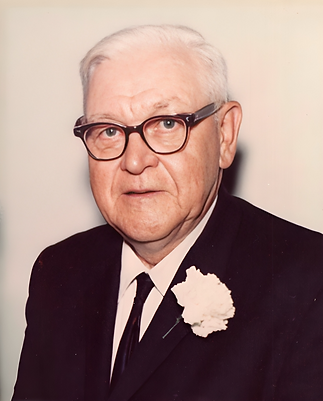
Oscar S. Smithback
Born: May 4, 1894
Died: May 28, 1974
Post 59 Commander: 1931
Branch: U.S. Army
Rank: Private First Class
Unit: Company K, 164th Infantry; 153rd Depot Brigade
Conflict: World War I
His Story
Oscar Selmer Smithback was born May 4, 1894, in Cambridge, Wisconsin, the son of Norwegian parents. A World War I Army veteran, businessman, and community leader, Smithback served as Commander of Otis Sampson Post 59 of The American Legion for the 1930–1931 term.
Smithback enlisted on May 23, 1917, at Dickinson, North Dakota, joining Company K, 1st Infantry of the North Dakota National Guard. The unit later became Company K, 164th Infantry. Beginning his service as a private, Smithback was promoted to corporal in November 1917 and to sergeant in July 1918.
His military service took him overseas from December 15, 1917, until February 26, 1919. Following his return to the United States, Sergeant Smithback was discharged at Camp Dodge, Iowa, on March 13, 1919.
After the war, Smithback eventually made his home in Stoughton and became active in Otis Sampson Post 59. In September 1930, Post members unanimously elected him Commander for the 1930–31 year. He was formally installed the following month during a Post meeting attended by Third District Legion Commander Lyall T. Beggs of Madison.
Smithback's life in Stoughton extended well beyond The American Legion. He spent many years in the meat business, working in Madison, Milwaukee, and Stoughton. By 1932, he had accumulated approximately 15 years of experience in the trade, including five years managing the retail meat department of Stoughton's Kroger store.
In December 1932, Smithback fulfilled a longtime ambition when he opened his own business, Smithback's Meat Shop, in the Hyland Building on West Main Street. A newspaper article announcing the opening described a modern black-and-white market equipped with contemporary displays and facilities. At the time, Oscar and his family lived at 215 N. Monroe Street in Stoughton.
Smithback also entered local public service. In 1933, he campaigned for Fourth Ward alderman in Stoughton, promoting what his campaign advertisement called "Honest and Fearless Representation for Everybody in the Fourth Ward."
Oscar married Phoebe Stickle in 1922. Together they raised a family that included twin daughters Alice and Aline, son James, and daughters Phoebe and Jane.
Smithback eventually left Stoughton and spent the later years of his working life in California. He was employed for many years by the Stoughton City Council before moving west and later worked for Morgan Co. in Hayward, California, retiring approximately 15 years before his death.
Oscar Selmer Smithback died May 28, 1974, at a hospital in San Francisco, California, at the age of 80. He was survived by his wife, Phoebe, their five children, three daughters-in-law, eight grandchildren, a brother, and a sister. Funeral services were held at Olson-Holzhuter Funeral Home in Stoughton, and he was buried at Cottage Grove Cemetery.
Oscar Smithback's story reflects the generation that helped establish and strengthen Otis Sampson Post 59 during its early decades—World War I veterans who returned home, raised families, built businesses, served their community, and remained active in the organization created to represent America's veterans.